Create and manage API keys and machine-to-machine credentials for connecting to the Endgame MCP server.
Deprecation: The Endgame REST API, including the /threads endpoints, has
been deprecated. API keys and machine-to-machine credentials are still
supported for connecting to the Endgame MCP server.
Use API keys and machine-to-machine (M2M) credentials when an agent or automation needs to connect to the Endgame MCP server without a person signing in, such as a Claude Managed Agent, a scheduled job, or a CI pipeline. If a person is connecting their own AI assistant, they should sign in with their Endgame account instead — see Getting started.Credentials are passed as a Bearer token in the Authorization header on requests to the MCP server:
Authorization: Bearer eak_your_api_key_here
The Endgame MCP server URL is:
https://app.endgame.io/api/v1/mcp
Two kinds of credentials are accepted. Both are provisioned from Endgame itself — you don’t need to configure anything in an external identity provider.
Server-to-server integrations that want short-lived OAuth tokens via the client_credentials grant.
Both are admin-only. Admins can see every API key and application running against Endgame, and how much each one is used, in the Automations view of the Console.
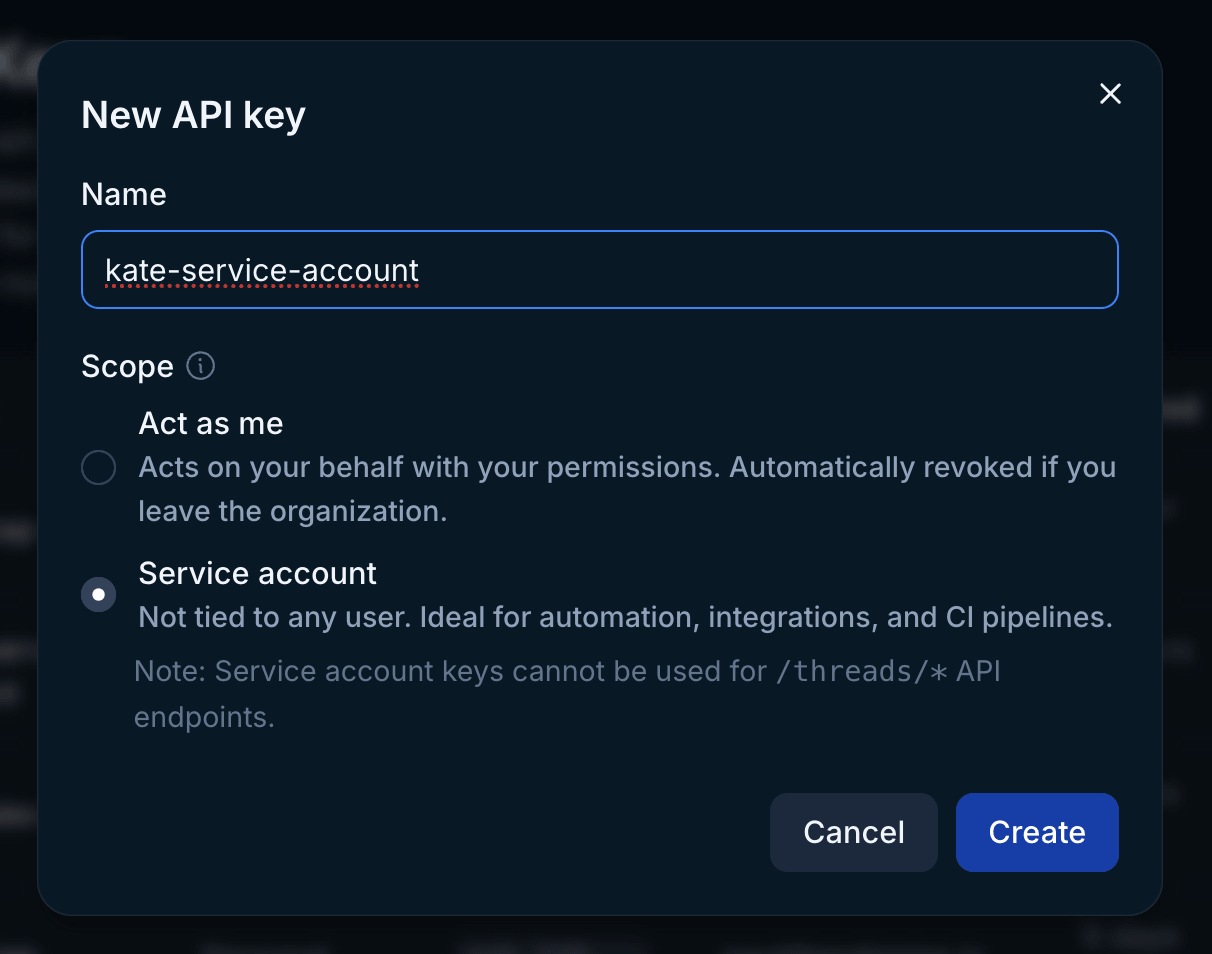
Give the key a descriptive name (e.g. deal-review-agent-prod) and pick a scope:
Act as me — Acts on your behalf with your permissions. Automatically revoked if you leave the organization.
Service account — Not tied to any user. Ideal for automation, integrations, and CI pipelines.
The full key is shown only once on creation — copy it immediately and store it in a secrets manager. The scope cannot be changed later.
Creating an API key in Endgame
3
Use the key to connect to the MCP server
Add the key as a Bearer token wherever your agent or MCP client is configured, with the server URL set to https://app.endgame.io/api/v1/mcp. For a step-by-step example, see Connect via Claude Managed Agents.
Use an M2M application when you need short-lived tokens issued per request (typical for production server-to-server integrations) rather than a long-lived static key.
You must be an admin in your Endgame organization to create applications.
Click New application, give it a descriptive name, and save. Endgame provisions a WorkOS OAuth client on your behalf and returns a client ID and client secret. The secret is shown only once on creation — copy it immediately into your secrets manager. You can rotate it later from the same page.
3
Exchange the credentials for an access token
Perform a standard OAuth client_credentials grant against WorkOS’s token endpoint:
API keys: revoke from the API Keys settings page — click Revoke next to the key’s row. Act as me keys are automatically revoked when the owning user leaves the organization. Service account keys persist until explicitly revoked.M2M applications: delete the application (or rotate its secret) from the Applications settings page. Deleting the application revokes all access tokens issued under it.Revocation is immediate in both cases; subsequent requests using a revoked credential fail with 401 UNAUTHORIZED.
Store credentials in a secrets manager. Never commit them to source control.
Use a separate credential per environment (dev, staging, prod) so rotation is scoped.
Give each one a descriptive name so revocation decisions are easy to audit.
Rotate on a regular cadence and whenever a team member with access leaves.
For shared or automated workflows, prefer Service account keys or M2M applications over Act as me keys, so access doesn’t depend on a single person staying in the organization.