> ## Documentation Index
> Fetch the complete documentation index at: https://docs.endgame.io/llms.txt
> Use this file to discover all available pages before exploring further.
# Ask Better Questions
> Master advanced prompting techniques to unlock Endgame's full potential
## Introduction
Endgame isn't just another search tool. It's your strategic thinking partner designed to help you build intuition and make better decisions about your accounts. The key to unlocking Endgame's full potential lies in how you communicate with it.
Think of Endgame like your most experienced sales colleague: the more context you provide and the more thoughtfully you frame your questions, the more valuable insights you'll receive.
## Core principles
The best teams use Endgame to think through their account strategy and what to do next. Don't just ask for information. Ask for analysis, recommendations, and strategic insights.
The more context-rich your question and the clearer you are about the outcome you want, the more useful Endgame will be. Specificity drives quality.
Treat Endgame like a teammate: probe, clarify, and iterate within one thread so insights compound. Your best results come from building on previous exchanges.
Endgame provides the information and analysis you need, but you should always review, test for accuracy, and frame your own narrative.
## Prompting framework
Different situations call for different prompting strategies. Use this framework to choose the right approach:
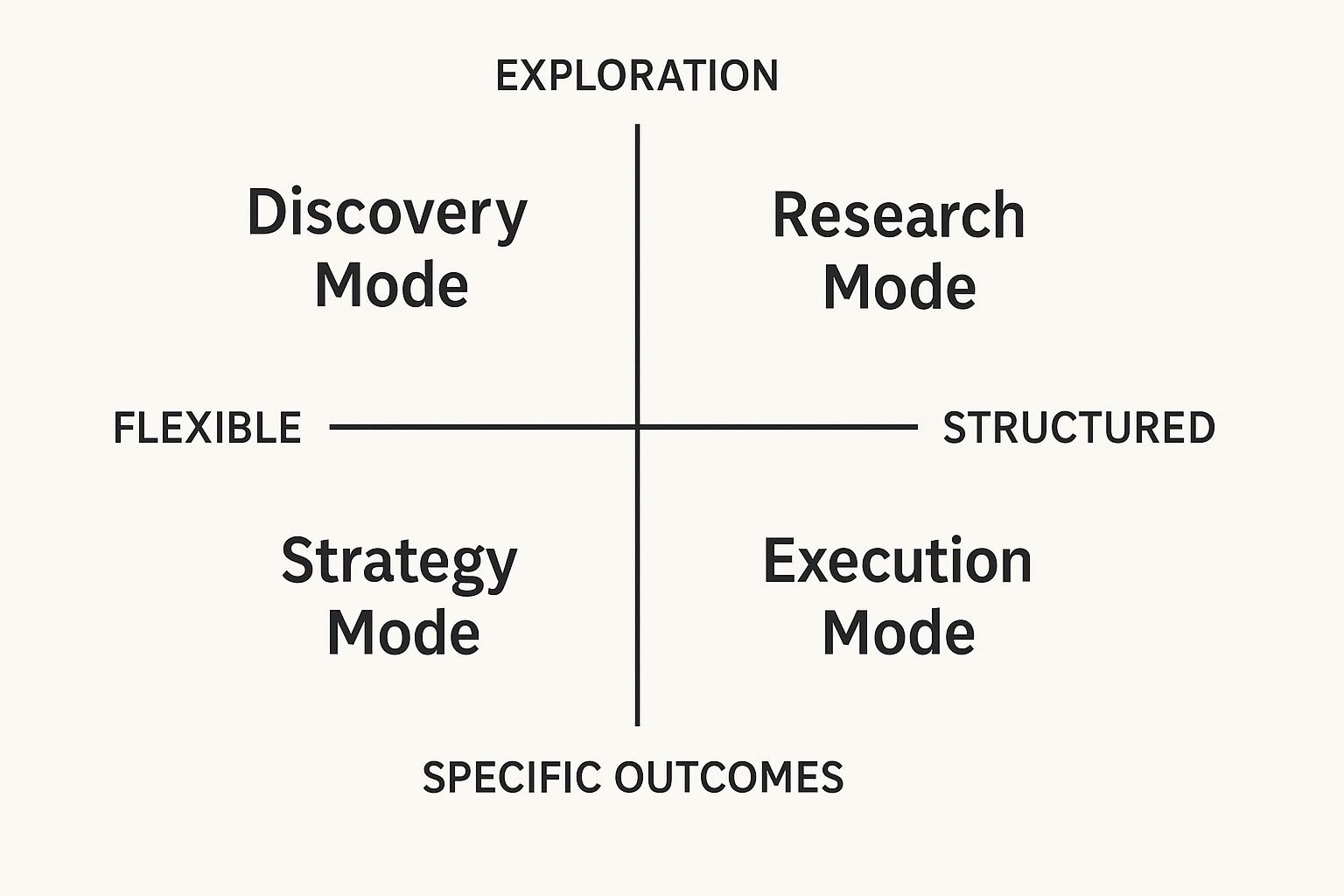 ### Flexible exploration for discovery
This approach is useful early in your account research, when you're not sure what you're looking for, or when you want to uncover unexpected opportunities.
**Approach:** Start broad, then narrow down based on what you discover.
**Example Pattern:**
* **Initial**: "What expansion opportunities exist at \[Company]?"
* **Clarify**: "Tell me more about the digital transformation angle you mentioned"
* **Refine**: "How urgent is this digital transformation for them specifically?"
### Structured exploration for research
This approach is useful when you want to systematically explore multiple angles or need comprehensive coverage of a topic.
**Approach:** Use frameworks and structured questions to ensure thorough analysis.
**Example Pattern:**
* **Initial**: "Analyze \[Company] across financial health, growth initiatives, and technology investments"
* **Dive deeper**: "Focus on their technology investments—what patterns do you see?"
* **Get tactical**: "Based on those patterns, what's our best entry point?"
### Flexible outcomes for strategizing
This approach is useful when you have a specific goal but are open to various approaches to achieve it.
**Approach:** State your objective clearly, then let Endgame suggest multiple paths.
**Example pattern:**
* **Initial**: "I need to get a meeting with their CTO. What approaches could work?"
* **Choose direction**: "I like the industry trends approach. What specific trends should I focus on?"
* **Get tactical**: "Draft a LinkedIn message using that angle"
### Structured outcomes for execution
This approach is useful when you know exactly what you need and want a specific deliverable.
**Approach:** Use the Intent → Context → Ask structure for precision.
**Example of the framework:**
* **Intent**: "I want to help my champion convince their CTO to pilot us"
* **Context**: "I know we've helped our champion build a tight ROI case, but we need the CTO to get excited by tying to near-term business priorities"
* **Ask**: "Can you write a 1-page business case that combines priorities, quotes, and ROI that my champion could email to her CTO?"
## Advanced techniques
Each conversation builds context. Reference previous insights: "Based on what we discussed about their Q3 priorities..." or "How does this new information change our approach from earlier?"
"I have 5 minutes with their CEO. What's the one thing I should say?" or "Explain this technical concept to a non-technical executive"
Don't settle for the first response. Push for better with: "Make it more specific to their industry" or "Add more urgency to the messaging"
Tell Endgame what you're trying to achieve and give it a draft prompt, then ask Endgame what it'd recommend the prompt should be
Ask Endgame to tell you what it recommends you should be focusing on to inform what you should ask. "How can I best utilize you to be more effective in my role?"
## Common pitfalls to avoid
**Bad:** "Tell me about this company"
**Better:** "What are the top 3 business challenges \[Company] is facing that our solution could help address?"
**Bad:** "Write me an email"
**Better:** "Write a follow-up email to the CTO I met last week who expressed interest in our security features but was concerned about implementation time"
**Bad:** Taking the first answer and moving on
**Better:** "This is helpful. Can you make the business case more specific to their retail operations?"
**Bad:** Using AI output without review
**Better:** Reviewing, fact-checking, and adding your own insights before using
## Conclusion
Successful use of Endgame comes from strategic conversations. Stress-test your thinking, explore new angles, and build conviction in your approach.
**Endgame is designed to help you think better, not just work faster**. Start with these frameworks, experiment, and find your own style. Your goal isn't to become a perfect prompter. It's to become a more strategic thinker who uses AI as a force multiplier for your expertise and judgment.
### Flexible exploration for discovery
This approach is useful early in your account research, when you're not sure what you're looking for, or when you want to uncover unexpected opportunities.
**Approach:** Start broad, then narrow down based on what you discover.
**Example Pattern:**
* **Initial**: "What expansion opportunities exist at \[Company]?"
* **Clarify**: "Tell me more about the digital transformation angle you mentioned"
* **Refine**: "How urgent is this digital transformation for them specifically?"
### Structured exploration for research
This approach is useful when you want to systematically explore multiple angles or need comprehensive coverage of a topic.
**Approach:** Use frameworks and structured questions to ensure thorough analysis.
**Example Pattern:**
* **Initial**: "Analyze \[Company] across financial health, growth initiatives, and technology investments"
* **Dive deeper**: "Focus on their technology investments—what patterns do you see?"
* **Get tactical**: "Based on those patterns, what's our best entry point?"
### Flexible outcomes for strategizing
This approach is useful when you have a specific goal but are open to various approaches to achieve it.
**Approach:** State your objective clearly, then let Endgame suggest multiple paths.
**Example pattern:**
* **Initial**: "I need to get a meeting with their CTO. What approaches could work?"
* **Choose direction**: "I like the industry trends approach. What specific trends should I focus on?"
* **Get tactical**: "Draft a LinkedIn message using that angle"
### Structured outcomes for execution
This approach is useful when you know exactly what you need and want a specific deliverable.
**Approach:** Use the Intent → Context → Ask structure for precision.
**Example of the framework:**
* **Intent**: "I want to help my champion convince their CTO to pilot us"
* **Context**: "I know we've helped our champion build a tight ROI case, but we need the CTO to get excited by tying to near-term business priorities"
* **Ask**: "Can you write a 1-page business case that combines priorities, quotes, and ROI that my champion could email to her CTO?"
## Advanced techniques
Each conversation builds context. Reference previous insights: "Based on what we discussed about their Q3 priorities..." or "How does this new information change our approach from earlier?"
"I have 5 minutes with their CEO. What's the one thing I should say?" or "Explain this technical concept to a non-technical executive"
Don't settle for the first response. Push for better with: "Make it more specific to their industry" or "Add more urgency to the messaging"
Tell Endgame what you're trying to achieve and give it a draft prompt, then ask Endgame what it'd recommend the prompt should be
Ask Endgame to tell you what it recommends you should be focusing on to inform what you should ask. "How can I best utilize you to be more effective in my role?"
## Common pitfalls to avoid
**Bad:** "Tell me about this company"
**Better:** "What are the top 3 business challenges \[Company] is facing that our solution could help address?"
**Bad:** "Write me an email"
**Better:** "Write a follow-up email to the CTO I met last week who expressed interest in our security features but was concerned about implementation time"
**Bad:** Taking the first answer and moving on
**Better:** "This is helpful. Can you make the business case more specific to their retail operations?"
**Bad:** Using AI output without review
**Better:** Reviewing, fact-checking, and adding your own insights before using
## Conclusion
Successful use of Endgame comes from strategic conversations. Stress-test your thinking, explore new angles, and build conviction in your approach.
**Endgame is designed to help you think better, not just work faster**. Start with these frameworks, experiment, and find your own style. Your goal isn't to become a perfect prompter. It's to become a more strategic thinker who uses AI as a force multiplier for your expertise and judgment.